Stars: 5 / 5
Recommendation: Who would have guessed that a single cup of tea could create a hurricane in the lives of three people – unexpected charity leads to forbidden attraction to shameless adultery to simple bigamy to mindless murder. Wonderful period detail about the 1920s New York City and the uncertainty of World War I creeps into this plot.
A Cup of Tea: A Novel of 1917 is a seductive romance novel by Amy Ephron first published on July 23, 1997. The story is set in New York City during the World War I and tells a tale of two women – Rosemary Fell and Eleanor Smith – who pursue the same man – Philip Alsop, Rosemary’s fiancé.
This novel is inspired by the 1992 short story A Cup of Tea by Katherine Mansfield. Ephron uses the same key characters and the basic plot from the original story. Ephron acknowledges the same in the opening page of the book.
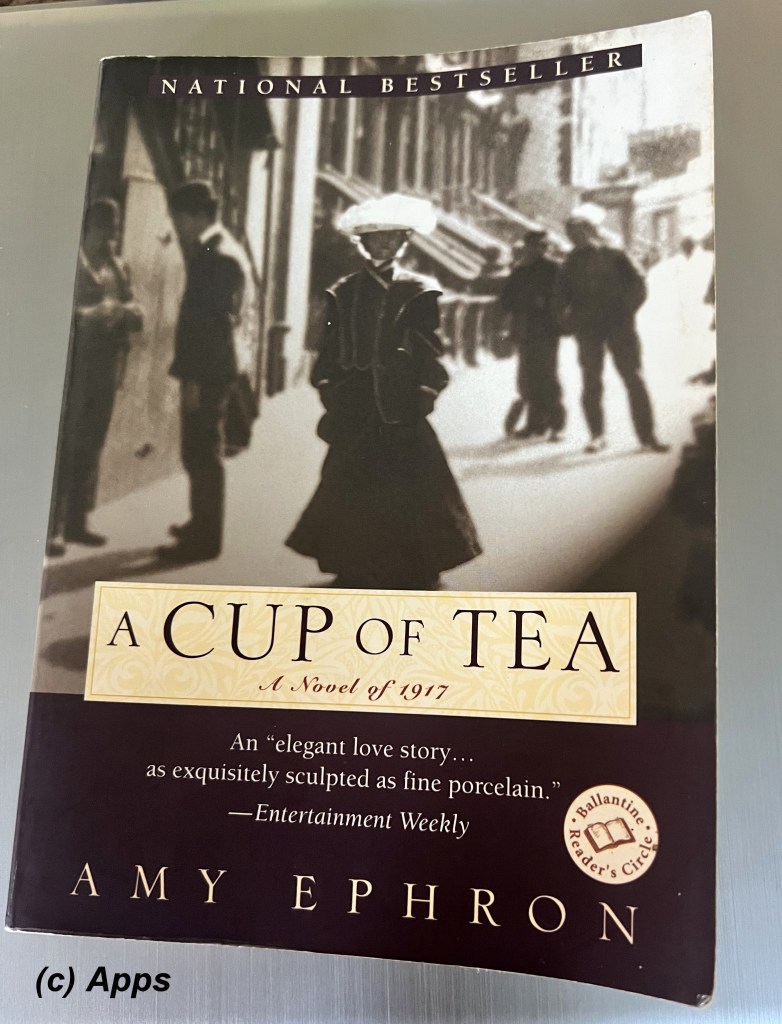
I have been going to Afternoon Teas with a few of my friends for a few years now. We as a group love to venture and find new places to enjoy this age-old British custom of afternoon tea. Naturally when one of my friends who champions these afternoon tea sojourns lent me this book I had to read it. Although there was no Afternoon Tea experience in the plot.
Recently I happen to go to this pretty tea room with my friends which came at an appropriate time when I finished reading this book. Look at the feast we had.

Rosemary and Eleanor are very different by not just virtue of their birth, but also circumstances, character and perspective towards one’s life situations. Rosemary comes off as haughty and superior of wealth although she is sweet, charming and benevolent per her whim. She has a very narrow view of perspective, where she feels she want to help only to make it an adventurous and fantastic tale to tell her friends. Even feel superior about helping someone in need. However, her character evolves a little in the middle of the plot, but basically she is snobbish with a limited capacity to think of others.
Eleanor on the other hand is shy and innocent looking at the same time there is something about her that says she is not as pure as she projects. She is strong-willed and definitely knows how to protect herself. Yet, she falls for the failure of her heart causing a rift in so many ways – among people, among her own ethics and a fight within herself. She is an enigma all through the book except for a brief look into her past. She largely left to reader’s imagination on how they want to perceive her.
Philip, the object of these two women’s affection, on the other hand has seen the world from both of their perspectives. Growing up poor, he had worked hard to build an empire in contrast to Rosemary’s upbringing as an upper social elite. With his two different backgrounds between childhood and adult life, its no wonder he was attracted to the forbidden. He should have been man enough to make the right decision before toying with the lives of three people.
The story goes beyond the original short story by Katherine Mansfield. The first few chapters are from the original, everything after is Ephron’s imagination. Although Ephron brings in the last dialogue of the original story (“Am I Pretty?”) into the middle of this story.
A tale that begins with a simple cup of tea takes us though the uncertain days of World War I, period detail about the 1920s New York City. Within the plot Ephron manages to weave in the gay and lesbian society that is hidden and forbidden for that time period. She also briefly indicates the impacts of war and being shellshock that leads to PTSD in soldiers.
She brings forth the social differences between women breaking down. One can see that the bubble of life that Rosemary built will no longer be the same with the likes of Dora and Eleanor encroaching it. Ephron puts in bits and pieces of duty and honor in the mix, but they get clouded with the selfish act of kindness and affairs of the heart.
I cant help buy pity for Rosemary despite her faulty view of world or her superior feeling. A small act of kindness leads to a travesty in her life. Eleanor and Philip are projected the better people, but in the end we see that they are not as superior as Rosemary either. In fact may be a little more inferior.
Author Ephron has a reader’s guide at the end of the book that forms sort of an interview. Also she included “Reading Group Questions and Topics for Discussion” with thought provoking points to ponder upon.
Who would have guessed that a single cup of tea could create a hurricane in the lives of three people – unexpected charity leads to forbidden attraction to shameless adultery to simple bigamy to mindless murder. Wonderful period detail about the 1920s New York City and the uncertainty of World War I creeps into this plot.
Spoiler Alerts:
1. Book Trivia and Plot Reveals:
    a. Characters in the plot: Mr. Rhenquist, antique shop owner; Gertrude, Rosemary's housekeeper; Jane Howard, Rosemary's best friend; Josie Kennedy, Eleanor's neighbor at the boarding house; Henry Fell, Rosemary's father; Dora, the proprietress of the hat shop; Jimmy Donahue, Josie's boy friend and co-actor; Robert Doyle, producer of Josie's shows.
    b. Jane and Dora are lovers, a lesbian concept that was forbidden.
    c. Robert Doyle is fascinated by Eleanor and her child, Tess (father: Philip), yet Eleanor doesn’t marry him.

2. Grammatical / Character / Plot / Geographical / Historical / Mythological Errors:
    a. On Pg. 21, when Eleanor fist meets Philip for the first time, the author doesn’t show any interaction between them other than each looking at each other. When introduced Eleanor doesn’t speak either, just looks. However, On Pg. 59 when Philip meets her at the hat shop he recognizes her by her voice and not by her looks. How did he recognize her voice when he hadn't heard her speak during the first meeting?
    b. On Pg. 182, Line 2, it should be "…Have I been…"
 Galavant Reflections